Aerospace Pitot Tube System
Queen’s Rocket Engineering Team (QRET) is a student design team that builds and designs a new supersonic rocket for competition each summer at the International Rocket Engineering Competition in Texas. Part of this competition involves recording flight performance data to improve the design of future years. One measure that is difficult to directly record with current onboard monitoring systems is the vehicle’s airspeed. QRET asked APSC 103 students to create a system to monitor and log the rocket’s velocity throughout the flight.
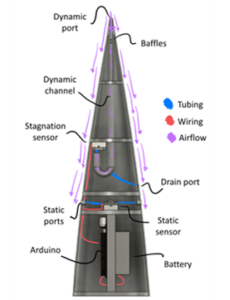
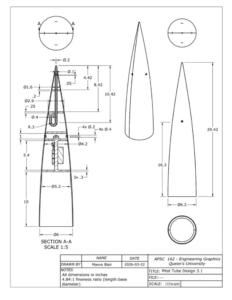
The team wanted to find a method to integrate a pitot tube onto the rocket airframe. Pitot tubes measure airspeed by comparing pressure differences between drag and ambient pressure, where this data can then be used to calculate velocity. This required the mechanical design of mounting the tube as well as electronic integration to record and process data.
The goal of this project was to design a pitot tube that could accurately and reliably measure the airspeed of a rocket during flight. The design should allow it to be effectively integrated into QRET’s rocket for the year. The design was to include all necessary electronic components to collect and store data as a stand-alone system.
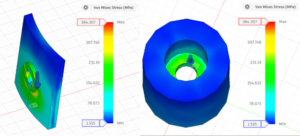
The rocket will reach a maximum altitude of 20 000 feet, causing pressures up to 120kPa and low temperatures of -19 degrees Celsius. The system will also be of minimal mass, capable of independent data collection, and supply its own 4-hour battery life. The team has provided a final design of the proposed pitot tube, a prototype for testing, an instruction manual, and a financial breakdown under the $300 budget. The physical prototype resembles that of the final design, with embedded Arduino code, battery source, and electrical components, but excludes ice mitigation and rocket integration, and differs in shape and sensor type. To ensure the feasibility of the design, finite element analysis was conducted, testing structural behavior at Mach 1.3, and the code was tested using the prototype. The pitot tube was held outside the window of a moving car, and the velocity calculated by the pitot tube was compared to that of the car’s accelerometer, utilizing code conversion accuracy.